




Oops! Something went wrong while submitting the form.

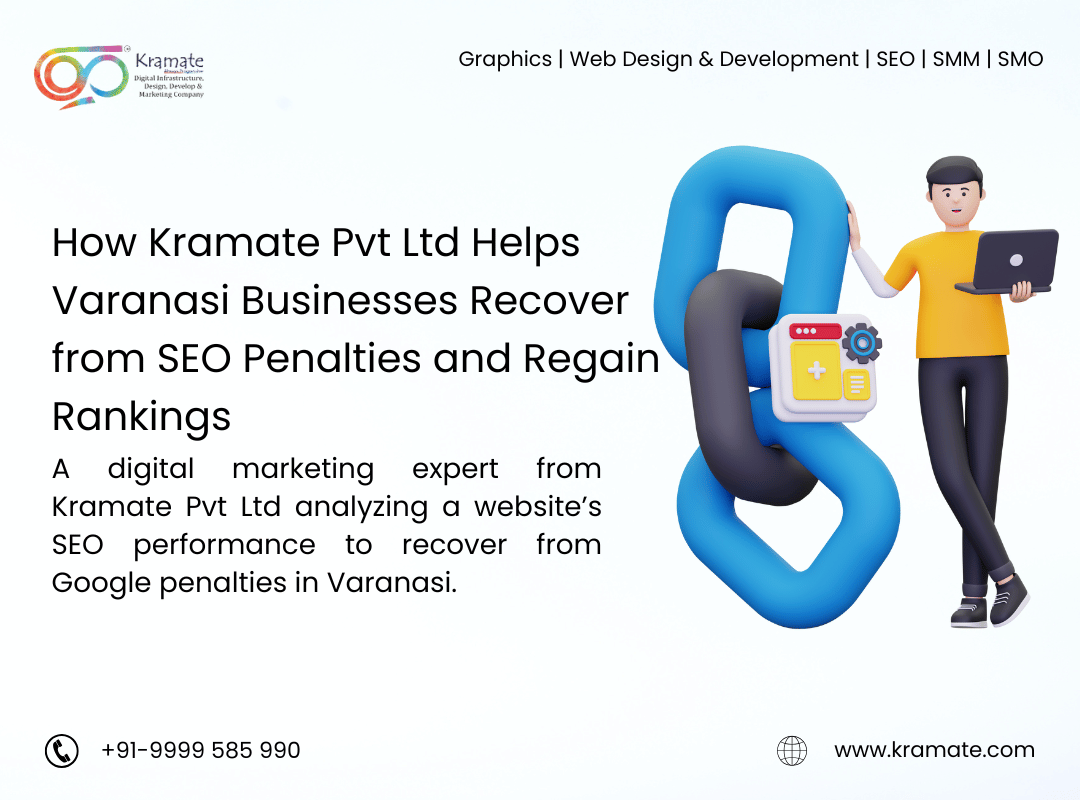


A sudden drop in Google rankings or organic traffic can be worrying for any business. However, a decline in traffic does not always mean that Google has penalized your website. It may be caused by a manual action, technical SEO problem, indexing issue, poor-quality content, backlink problems, changing search demand, stronger competitors, or changes in Google's ranking systems.
For businesses in Varanasi, losing organic visibility can directly affect enquiries, bookings, calls, website visitors, and sales. Hotels, restaurants, travel agencies, educational institutes, healthcare providers, real estate companies, e-commerce businesses, and local service providers all depend on search visibility to reach potential customers.
This guide explains how to identify the real reason behind a Google ranking decline, how to recover from a genuine SEO penalty, and how Varanasi businesses can build a healthier long-term SEO strategy.
To recover from a Google SEO penalty, first determine whether the website has received a manual action or is simply experiencing a ranking decline for another reason.
Start by checking Google Search Console, especially the Manual Actions section. Then review indexing, technical SEO, website content, backlinks, internal linking, recent website changes, and search performance.
If Google has issued a manual action, identify the specific violation, fix the underlying problem across the affected pages, document the changes, and follow Google's review process when applicable.
If there is no manual action, investigate technical problems, content quality, search intent, competitors, lost backlinks, indexing issues, and changes in search demand before assuming that your website has been penalized.
For Varanasi businesses, the recovery process should also include local SEO, Google Business Profile information, location-specific content, customer reviews, and local search visibility.
A Google SEO penalty is a commonly used term for a significant loss of search visibility associated with spam or violations of Google's search policies.
However, the phrase "Google penalty" is often used too broadly.
Not every sudden ranking or traffic decline is a penalty.
A website may lose rankings because of:
A manual action
Algorithmic ranking changes
Technical SEO problems
Indexing issues
Poor-quality content
Duplicate content
Unnatural SEO practices
Backlink problems
Website migration errors
Changes in search intent
Increased competition
Seasonal changes in demand
Lost backlinks
Changes in Google's search results
Therefore, the first step in SEO penalty recovery should always be diagnosis.
Instead of immediately deleting pages, changing keywords, or removing backlinks, first determine what actually caused the visibility decline.
Understanding the difference between these two situations is one of the most important parts of SEO recovery.
| Factor | Google Manual Action | Algorithmic or Ranking Drop |
|---|---|---|
| Main cause | A Google reviewer identifies a policy or spam issue | Ranking systems, competition, content, technical issues or search changes |
| Search Console | A manual action may be displayed | Usually no manual action is displayed |
| Affected pages | Can affect specific pages or wider sections | Can affect one or many pages |
| Recovery approach | Fix the identified violation and follow Google's process | Diagnose and improve the underlying SEO problems |
| Reconsideration | May be applicable | Generally not applicable |
| Recovery time | Depends on the issue and review process | Depends on cause, competition and website quality |
This distinction matters because the wrong recovery strategy can waste time and potentially create additional problems.
A website experiencing an SEO problem may show one or more of the following signs:
Organic traffic suddenly decreases
Important keywords lose rankings
Search impressions decline
Clicks from Google decrease
Important landing pages lose visibility
Pages disappear from search results
New pages are not getting indexed
Organic enquiries or leads decrease
Search Console reports a manual action
Large numbers of pages become excluded from indexing
Rankings decline shortly after a website migration
A major change in traffic occurs after technical website changes
However, none of these signs alone proves that Google has penalized your website.
A detailed investigation is necessary.
If your website suddenly loses Google rankings, check these five areas first:
Check Manual Actions, search performance, indexing and other important reports.
Make sure your important pages are still available to Google and have not accidentally been blocked.
Review recent redesigns, migrations, URL changes, redirects, canonical tags and other technical modifications.
Check whether affected pages are useful, accurate, original, up-to-date and aligned with the search intent.
Review the backlink profile for unnatural or manipulative patterns before taking corrective action.
Before beginning a recovery campaign, perform a structured diagnosis.
Google Search Console should be one of the first places you investigate.
Review the Manual Actions section to determine whether Google has reported a specific policy issue.
Also examine:
Search clicks
Search impressions
Average position
Search queries
Top pages
Indexing status
Page indexing issues
Crawl-related information
Security issues
Look for the date when the decline began and compare it with major changes to the website.
Compare your current organic traffic with previous periods.
For example, compare:
Last 7 days
Last 28 days
Previous 3 months
Same period in the previous year
Look at whether the decline affects the entire website or only particular pages.
If only a few pages lost traffic, investigate those pages individually.
If almost the entire website experienced a major decline, investigate broader technical, indexing, content, backlink or search-system changes.
A website can lose organic visibility because important pages are no longer properly indexed.
Check:
Robots.txt
Noindex tags
Canonical URLs
XML sitemap
Redirects
Broken pages
Internal links
HTTP status codes
For example, if important pages accidentally receive a noindex directive, the resulting traffic decline may look like an SEO penalty even though the actual problem is technical.
A complete SEO audit should examine the website from multiple angles.
Review:
Technical SEO
Content quality
Backlinks
Internal linking
Website structure
Metadata
Indexing
Mobile usability
Page experience
Structured data
URL structure
Redirects
Important landing pages
The purpose of the audit is not simply to collect hundreds of SEO errors.
The objective is to identify the problems most likely to be responsible for the ranking decline.
After completing the audit, separate critical problems from minor recommendations.
For example, the following may require immediate attention:
Important pages accidentally blocked
Incorrect noindex tags
Major migration errors
Manual actions
Large-scale duplicate content
Serious technical problems
Minor title or metadata improvements can be addressed after critical issues have been resolved.
This prioritization makes the recovery process more efficient.
Technical SEO is an important part of website recovery.
Check:
Crawlability
Indexability
Canonical tags
Redirects
Robots.txt
XML sitemap
Broken links
Duplicate URLs
HTTPS
Mobile usability
Page speed
Website architecture
Internal linking
A technically healthy website helps search engines discover, crawl, understand and index important content.
Content is another major area to investigate.
Review pages that are:
Thin
Outdated
Repetitive
Copied
Generic
Poorly structured
Created mainly for search engines
Not satisfying user intent
Instead of simply adding more words, improve the actual usefulness of the page.
Good content should answer the user's question clearly and provide information that is accurate, useful and relevant.
For example, if you are writing about SEO penalty recovery in Varanasi, the article should explain how businesses can diagnose ranking problems, identify manual actions, fix technical issues, improve content and recover organic visibility.
Simply repeating "SEO penalty recovery in Varanasi" throughout the article does not make it more useful.
Keywords are useful for communicating the topic of a page, but excessive keyword repetition can make content unnatural.
Instead of repeatedly using one phrase, use natural topical language.
For this topic, relevant terms can include:
SEO penalty recovery
Google ranking recovery
Google manual action
SEO audit
Technical SEO
Website ranking drop
Google Search Console
Content quality
Backlink audit
Local SEO
Organic traffic recovery
SEO consultant
The goal should be topical relevance rather than keyword density.
Backlinks should be reviewed carefully when investigating an SEO problem.
Look for:
Unnatural link patterns
Manipulative links
Irrelevant links
Links created specifically to manipulate rankings
Large numbers of suspicious links
Paid or artificial link-building practices
However, do not assume that every low-quality or unfamiliar backlink is harmful.
A backlink audit should consider the source, context, pattern and reason for the link.
The Google Disavow Tool should also not be treated as a routine SEO cleaning tool.
It should be considered carefully and only when appropriate.
Internal linking helps users and search engines discover related pages.
Create logical connections between:
SEO services
Technical SEO
Local SEO
Content marketing
Google Search Console
Website development
Backlink audit
Related SEO guides
For example, this article can link naturally to a detailed technical SEO guide or local SEO guide.
Avoid adding internal links simply to increase the number of links.
Each link should provide a useful next step for the reader.
One of the most overlooked SEO recovery steps is search-intent analysis.
Ask:
What does the person actually want when they search this keyword?
For example, someone searching:
"How to recover from Google SEO penalty"
is probably looking for:
Causes
Symptoms
Diagnosis
Recovery steps
Manual action information
Backlink advice
Content advice
Recovery timelines
They are not necessarily looking for a long sales pitch about an SEO agency.
Therefore, informational content should answer the user's questions first and introduce commercial services naturally afterward.
If Google Search Console reports a manual action, carefully read the information provided.
Identify:
The type of issue
Affected pages
The reason for the action
Required corrective steps
Then address the underlying problem.
For example, if the issue relates to spam practices, stop the practice and clean up affected pages.
If it relates to unnatural links, investigate the backlink profile and take appropriate corrective action.
If it involves low-quality content, improve or remove the problematic content as appropriate.
After completing the required changes, document what was fixed and follow Google's reconsideration process if applicable.
A strong reconsideration request should clearly explain:
What went wrong
Why it happened
What was corrected
Which pages were affected
What steps were taken to prevent the problem from happening again
If there is no manual action, do not automatically assume that your website has been penalized.
Instead, investigate:
Which pages lost rankings
Which queries declined
When the decline began
Whether search intent changed
Whether competitors improved
Whether content is outdated
Whether technical problems exist
Whether important backlinks were lost
Compare your affected pages with pages currently ranking well.
Look for differences in:
Content quality
Topic coverage
Search intent
Expertise
Usefulness
Local relevance
Page experience
Internal linking
Then improve the areas where your website is genuinely weaker.
| Step | What to Check | Recommended Action |
|---|---|---|
| 1 | Google Search Console | Check Manual Actions and performance |
| 2 | Indexing | Check robots.txt, noindex, sitemap and canonical |
| 3 | Technical SEO | Fix crawl, redirect, speed and mobile issues |
| 4 | Content | Improve thin, outdated or repetitive content |
| 5 | Keywords | Remove excessive keyword repetition |
| 6 | Backlinks | Review unnatural or manipulative patterns |
| 7 | Internal Links | Build logical topic connections |
| 8 | Local SEO | Improve local business relevance |
| 9 | Monitoring | Track clicks, impressions, rankings and leads |
Varanasi is a competitive local market with businesses serving both local customers and visitors from different parts of India and abroad.
Online visibility can be particularly important for:
Hotels
Restaurants
Travel agencies
Tour operators
Educational institutes
Healthcare businesses
Real estate companies
Local retailers
Professional services
E-commerce businesses
For these businesses, SEO recovery should not focus only on generic website rankings.
It should also consider local search visibility.
A Varanasi business should review the following areas during an SEO recovery campaign.
Make sure important business information is accurate and consistent.
Check the consistency of:
Business name
Address
Phone number
Website
Business category
Local pages should contain genuinely useful information instead of simply replacing city names in identical templates.
Encourage genuine customer feedback and avoid manipulative review practices.
Create content that answers real questions from customers in Varanasi and people planning to visit or do business in the city.
| Business Type | Common SEO Problem | Recovery Focus |
|---|---|---|
| Hotels | Repetitive location pages and weak local content | Local SEO and useful accommodation information |
| Travel Agencies | Similar tour-package pages | Unique destination and itinerary content |
| Restaurants | Weak local search visibility | Local SEO and accurate business information |
| Educational Institutes | Thin course or location pages | Detailed course and student-focused content |
| Real Estate | Duplicate property and location content | Unique property and locality information |
| Healthcare | Weak trust and informational content | Accurate and trustworthy information |
| E-commerce | Duplicate product and category pages | Technical SEO and unique product content |
| Local Services | Weak service-area pages | Service-specific and locally relevant content |
This approach is more useful than creating dozens of pages that simply repeat the same keyword with different Varanasi neighbourhood or service names.
Travel websites can face a specific content challenge because they often create many destination and package pages.
For example, a travel website might publish:
Varanasi Tour Package
Varanasi Family Tour
Varanasi Couple Tour
Varanasi to Ayodhya Tour
Varanasi to Chitrakoot Tour
Varanasi Temple Tour
These pages should not all contain nearly identical content.
Each page should have a distinct search intent.
For example, a Varanasi to Chitrakoot tour page can provide:
Route information
Distance
Travel options
Suggested itinerary
Major attractions
Temple information
Family travel tips
Transportation options
Approximate travel duration
Best time to travel
This creates genuine value for users instead of simply adding keywords to the page.
AEO, or Answer Engine Optimization, focuses on making information easy for search engines and answer systems to understand and extract.
For an SEO penalty recovery article, use clear question-and-answer sections.
Examples include:
A Google SEO penalty is a commonly used term for a significant loss of search visibility associated with spam or policy violations. However, not every ranking decline is a penalty.
Open Google Search Console and review the Manual Actions section. If Google has issued a manual action, relevant information may be displayed there.
Unnatural or manipulative link practices can create SEO problems, but not every unfamiliar or low-quality backlink is harmful. Backlinks should be reviewed in context.
There is no universal recovery timeline. It depends on the cause, severity, website condition, competition, corrective actions and Google's crawling and review processes.
This answer-first structure makes the content easier to understand for both users and answer-focused search experiences.
GEO, or Generative Engine Optimization, requires content to provide clear, reliable and context-rich information that can be understood by AI-powered search and answer systems.
For a Varanasi-focused SEO article, avoid using the location only as a keyword.
Instead, provide real local context.
For example:
A hotel in Varanasi may need to optimize content around accommodation, local attractions, transportation, guest questions and booking information.
A travel agency may need useful content about temple visits, routes, itineraries, transportation and nearby destinations.
A local service business may need service-specific information, operating areas, customer questions and business details.
The location should add meaning to the content rather than simply appearing repeatedly in headings.
A ranking decline can cause businesses to make rushed SEO decisions.
Avoid these mistakes.
| Do This | Avoid This |
|---|---|
| Analyze Search Console data | Panic and delete the website |
| Perform a technical audit | Change everything without diagnosis |
| Improve useful content | Keyword stuffing |
| Review backlinks carefully | Buy bulk low-quality links |
| Analyze search intent | Copy competitor content |
| Improve local relevance | Create hundreds of duplicate location pages |
| Monitor results | Expect instant recovery |
| Use verified data | Publish unsupported SEO claims |
There is no fixed recovery time for every website.
The timeframe depends on:
Type of problem
Severity of the issue
Number of affected pages
Website history
Technical condition
Content quality
Website authority
Competition
Crawling and indexing
Quality of corrective work
Manual review requirements, when applicable
Some technical problems can be corrected relatively quickly.
However, rebuilding organic visibility can take considerably longer.
A website should therefore be evaluated over time rather than expecting rankings to return immediately after one change.
| Recovery Stage | Main Activity |
|---|---|
| Initial Diagnosis | Search Console and website investigation |
| Problem Identification | Find the main cause and affected pages |
| Technical Fixes | Resolve crawl, index, redirect and website issues |
| Content Improvements | Improve quality, relevance and search intent |
| Backlink Review | Investigate unnatural or manipulative patterns |
| Local SEO | Improve relevant Varanasi business signals |
| Monitoring | Track traffic, rankings and conversions |
| Further Optimization | Make additional improvements based on data |
SEO recovery should focus on improving the website rather than guaranteeing a particular ranking position.
No responsible SEO professional can guarantee that a website will rank at number one for a competitive Google keyword.
Ranking depends on many factors, including:
Competition
Search intent
Content quality
Website authority
Technical SEO
Search systems
User behaviour
Industry
Location
A professional SEO strategy should therefore focus on measurable improvements such as better organic visibility, relevant traffic, stronger landing pages, improved technical health and increased qualified enquiries.
Kramate Pvt Ltd can help businesses approach SEO recovery through a structured, diagnosis-first process.
Instead of assuming that every traffic decline is a Google penalty, the focus should be on identifying the actual technical, content, backlink, indexing and local SEO problems affecting the website.
Depending on the website's requirements, an SEO recovery strategy may include:
Website SEO audit
Technical SEO analysis
Content quality review
Search intent analysis
Internal linking improvement
Backlink analysis
Local SEO evaluation
Website performance review
Search Console analysis
Ongoing SEO monitoring
The strategy should be customized according to the business and the cause of the ranking problem.
A Varanasi hotel may need a different recovery strategy from a travel agency, educational institute, e-commerce business or local service provider.
Use this checklist if your Varanasi business website has suddenly lost Google visibility.
☐ Google Search Console checked
☐ Manual Actions checked
☐ Organic clicks compared
☐ Organic impressions compared
☐ Ranking changes analyzed
☐ Important pages checked for indexing
☐ Robots.txt reviewed
☐ Noindex tags reviewed
☐ Canonical tags reviewed
☐ XML sitemap reviewed
☐ Redirects checked
☐ Technical SEO audit completed
☐ Content quality reviewed
☐ Duplicate content checked
☐ Keyword stuffing checked
☐ Backlink profile reviewed
☐ Internal linking reviewed
☐ Local SEO signals checked
☐ Google Business Profile reviewed
☐ Search intent analyzed
☐ Competitor pages compared
☐ Recovery progress monitored
A Google SEO penalty is a commonly used term for a significant search visibility problem associated with spam or policy violations. However, not every ranking decline is a penalty. A proper diagnosis is necessary before deciding on a recovery strategy.
Check the Manual Actions section in Google Search Console. If Google has issued a manual action, Search Console can provide information about the issue and affected areas of the website.
No.
Traffic can decline because of technical problems, indexing issues, changes in search demand, stronger competitors, content decay, search-system changes, lost backlinks, or a manual action.
Unnatural or manipulative link practices can create SEO problems. However, not every low-quality or unfamiliar backlink is harmful. Backlinks should be evaluated carefully before taking corrective action.
The disavow tool should be used carefully and only when appropriate. It should not be treated as a general tool for removing every backlink that appears unfamiliar or low quality.
Substantially repetitive or duplicate content can create indexing and quality challenges, particularly when many pages provide little unique value. Review the affected pages and improve, consolidate or remove content where appropriate.
There is no fixed recovery period. It depends on the cause, severity, website condition, competition, corrective work and, where applicable, Google's review process.
Recovery may be possible when the underlying cause is identified and properly addressed. The strategy depends on whether the problem is technical, content-related, backlink-related, local SEO-related or associated with a manual action.
Professional SEO assistance may be useful when a website experiences a major unexplained traffic decline, receives a manual action, has complex technical problems, has a history of aggressive SEO practices or requires a detailed recovery strategy.
No responsible SEO professional can guarantee a specific Google ranking position. SEO recovery focuses on fixing problems, improving website quality, increasing relevance and building sustainable organic visibility.
Recovering from an SEO penalty or major Google ranking decline starts with accurate diagnosis.
The biggest mistake is assuming that every traffic drop is a Google penalty and immediately changing everything on the website.
For businesses in Varanasi, a sustainable SEO recovery strategy should combine technical SEO, high-quality content, careful backlink analysis, strong internal linking, useful local information, accurate business signals and continuous performance monitoring.
If your website has lost organic visibility, start with Google Search Console and a complete SEO audit.
Find out what changed, identify the pages and queries affected, determine the actual cause, prioritize the most important fixes and monitor the results over time.
The objective should not simply be to regain rankings.
The objective should be to build a technically healthy, useful, trustworthy and search-friendly website that can maintain organic visibility over the long term.
If your Varanasi business website has experienced a sudden decline in organic traffic, don't immediately assume that Google has penalized it.
Start with a detailed SEO audit to understand what changed, which pages were affected and what should be fixed first.
Kramate Pvt Ltd can help businesses evaluate technical SEO, content, backlinks, local SEO and website performance to develop a practical SEO recovery strategy based on the website's actual needs.
Engage the Best Website developers and Beat the Competition





Kramate is an award-winning performance marketing agency.We deliver transformational growth for our clients through digital excellence








.png)
